Old & Slow #13
By Bill Elder
Transportation 2

|
|
Old & Slow #13
By Bill Elder |
|
|
It seems that a lot of
my best memories of my days in Transportation are from my early days.
There are several reasons for this. In the first place, I had no
real responsibility except to come to work every day and learn as
much. The equipment in those days was very
simple and maintenance revolved around repairs rather than preventive
maintenance. This carefree world was about to come to an end.
I completed my apprenticeship and was immediately offered the job
of foreman because of my supervisory experience in the engine plant.
Canada also introduced a new Preventive Maintenance standard to all
transportation trucks and trailers operating in Canada. The first
step was to initiate a schedule for the Preventive Maintenance where
the entire fleet was placed on a schedule. Each month a group of
trucks and trailers had to have an in-depth yearly inspection. We
had to purchase booklets from the government. The booklets showed a
list of components that had to be inspected. The sheets were in
triplicate, serialized and there was a sticker that had to be
punched out showing the date of the inspection. The mechanics would
have to sign off on the sheets. One copy stayed in the equipment;
the other two sheets went into separate files for each unit and the
sticker had to be placed on the equipment in the area mandated by the
government. If this sounds like a serious program, let me assure you
it was. If there was an accident on the road and it could be shown
that it occurred because the maintenance was not performed to
standard, the mechanic who had signed off was going to jail, his
supervisor (me) was going to jail and as I liked to tell my boss, he
was going to jail. Serious indeed!
GM
and Ford did not maintain their own transportation fleets but Chrysler did.
I always
told my guys; Transportation is a non core part of the company. We
could not afford to be careless. Think of the family of five driving
along and being involved in an accident due to our neglect.
That would be the end for us. So we exceeded the government
standards. We had our own inspection sheets that were much more
detailed than the government sheets and we did not just rely on
yearly inspections. Besides the yearly inspections, the trucks had
minor inspections every 4 months and the trailers came in for a minor
inspection every six months. The government wanted the thickness of
the brake shoes recorded at the yearly inspections. Although this could be
done through the backing plates, we insisted on pulling the
wheels at every yearly inspection. One benefit of this was ensuring
a thorough grease job on the brake cams which insures the best
braking performance. There was also a general benefit for the garage.
Even if the plant shut down and the entire fleet was parked, the
Preventive Maintenance had to be kept on schedule. So we never had
a layoff -- we had steady employment.
When I first came to
the garage, the trailers could be summed up in one word “scary”.
They were old and very few of the vans had doors. The cargo was kept
inside by having chains welded to the door frame with hooks. The
chains were simply crisscrossed and hooked together. Engines were
transported on huge open racks on flat bed trailers. I will go on
record as saying the trailers' worst enemies were the fork lift
drivers who loaded them. The early trailers were aluminium
sided and roofed and were no match for the “jitney assassins”.
If they weren’t punching holes through the roofs, they were
ripping the sides out. If we protested to the Supervisors on the
loading docks, we were ignored. It was all about making break times
for themselves. Ram the racks in and take a break. As new trailers
were specified, we upped the interior protection by adding all kinds
of metal to the ceilings and at the area where the sides met the
floors. One great advancement in trailer design was the use of
composite panels in the sides and roofs instead of the posts and
aluminum sheets. The composite panels are an epoxy filler sandwiched
between two thin layers of metal. Today, I see the trailers that
were ordered in 2015 still in service and doing the job.
There were three
wreckers at the garage when I started; a small unit based on a Dodge
pickup which we used for cars and two converted LCF (low cab forward) Dodges we used for trucks. Both trucks
had 413 truck motors. One was a single axle and could only be used
for flat towing of trucks but it could pick up trailers. The other
was a tandem axle 413 powered LCF. It was interesting because it
had two transmissions -- a five-speed backed up by a four speed. If you
haven ever heard of it, it is called the legendary twin stick. If you put both
transmissions in low, the truck moved so slow you would have to pick a spot on the ground to
verify the truck was moving but it was so strong you could pull a
building down with it. The problem with both trucks was the lack of
weight in the front. You could pick up a diesel tractor from the
back with old twin stick, but picking a diesel tractor up from the
front was marginal.
I went on a service
call with one of the mechanics one night. One of our Detroit Diesel
trucks broke down on the freeway at the approach to the Ambassador
Bridge. We had to pass by the truck and double back to it on the
freeway. The way it was parked, the only thing we could do was
pick up the dead diesel by the
front. While we were prepping the rear axles a light snow started
making it slightly slippery. We got everything hooked up and started
for home. If you have ever been on the Ambassador bridge, you will
know that at the bottom of the descent coming into Canada the roadway
curves to the left. So here we are coming down the bridge and the
mechanic turns the steering wheel to the left. The wrecker is
skipping along saying, “I don’t think I want to turn.”
I was thinking that we are going over and the best-case scenario
will be that I will only need a change of coveralls. Again, if you
know the Ambassador, there is a high curb along the roadway. With
the steering wheels turned all the way to the left, the curb just
kind of guided us around the bend.
The old truck plant
(The Maxwell Plant) had closed by this time and production was
converted to quality assurance for the new Fuel Injected Imperials.
When the old truck plant closed, we were able to scavenge a huge
quantity of truck parts including three LCF cabs, numerous hoods,
fenders and crossmembers. That winter we ordered a pair of bus frame
rails and pirated a Cummins drivetrain from one of the road trucks.
Using our scavenged parts, we put together a long wheel base rolling
and driving chassis that was to become the basis for a new wrecker.
In the spring, we took the winch and some other components off the
old single axle wrecker and built the new wrecker. The entire
wrecker body, booms and bridle was fashioned by the very talented
group of metal welders and body men that we had working in our shop.
In 1987, we bought the lease out on a 1981 International Tractor and
that became our next wrecker. This one had the frame professionally
lengthened and the entire unit came from a wrecker builder in
Montreal. The old Dodge continued to serve for many years until the
frames became weak from all of the usage over the years. There is a
Transportation Museum in the Windsor area. I lobbied to have the old
Dodge gifted to them. They have a large property and over the years
they have moved a number of historic buildings to the site along with
the historic vehicles. We finally got upper management to allow the
old Dodge to retire there after the museum folks signed a waiver
that they would not use the wrecker for anything other than as a
display vehicle. A fitting retirement for an old, beloved workhorse!
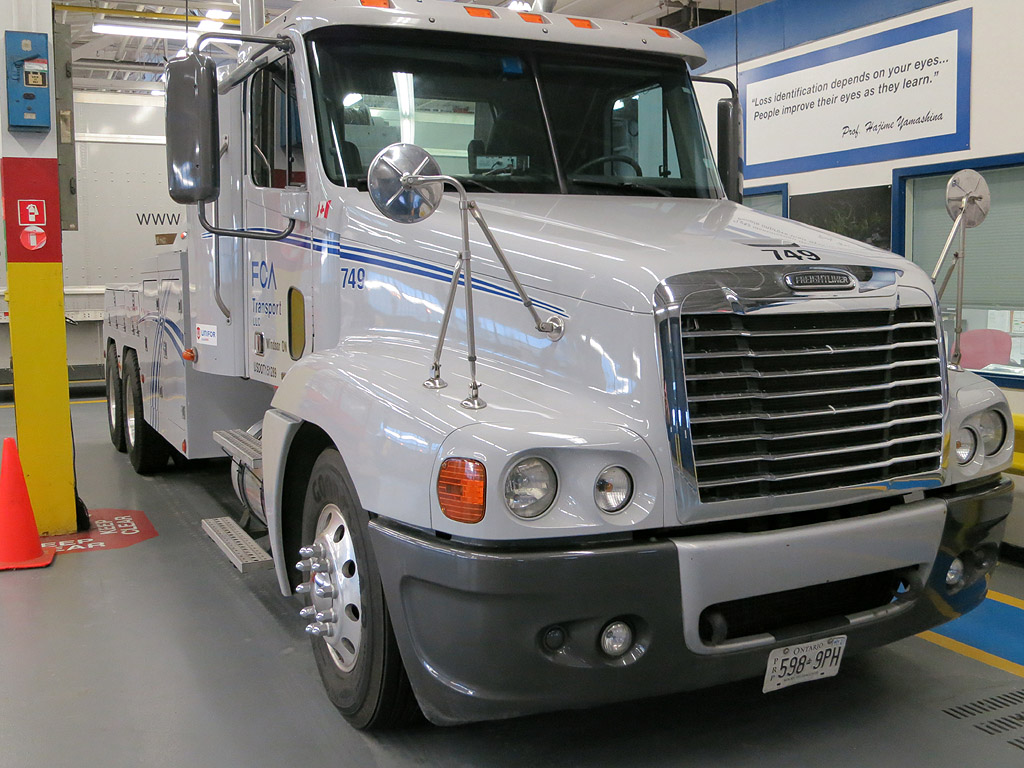
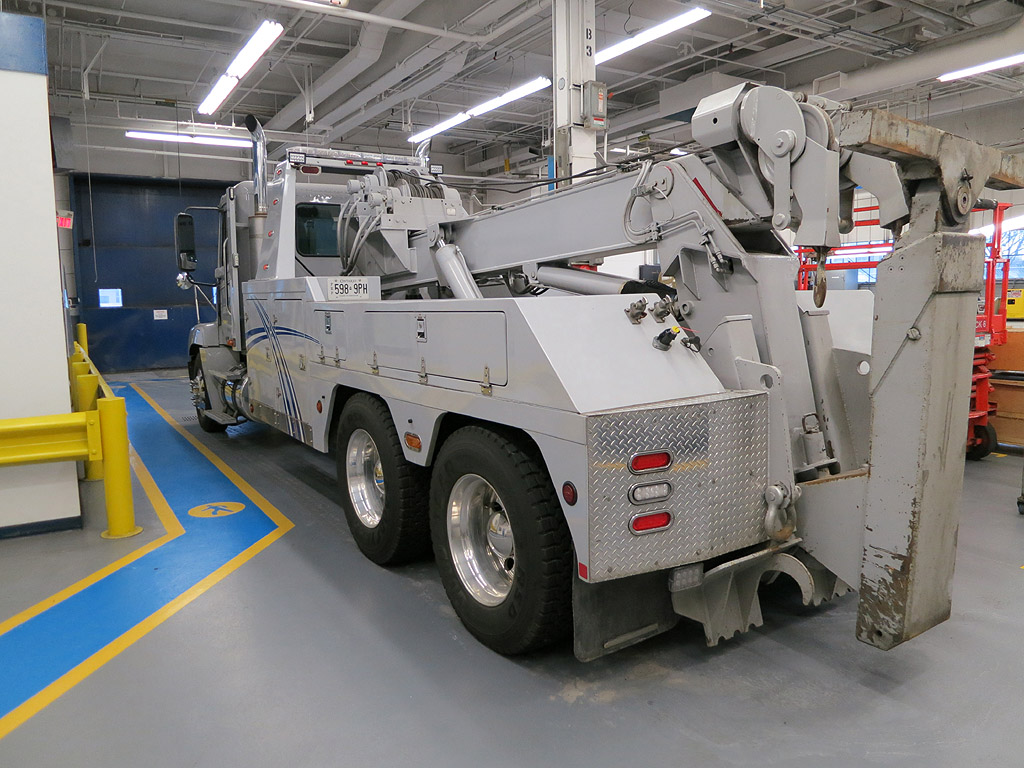
The current wrecker is a 2005 Freightliner. The frame on the 1981 International had rotted out between the inner and outer frames and huge cracks had developed. So when the 2005 Freightliners came due for retirement, we were able to purchase the truck with the lowest mileage. We sent the truck to a professional wrecker shop. They lengthened the frame, installed inner frame rails and certified the ABS brakes. Meanwhile we stripped the wrecker body off the International and revamped it totally. The control unit, which had aluminium pistons, had corroded over the years. We upgraded it with brass pistons and all new hydraulic lines. We are all very proud of that truck. If you were to buy a new wrecker, I am sure the price would exceed $250,000. We did the Freightliner for less than $75,000.
|